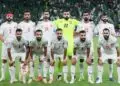



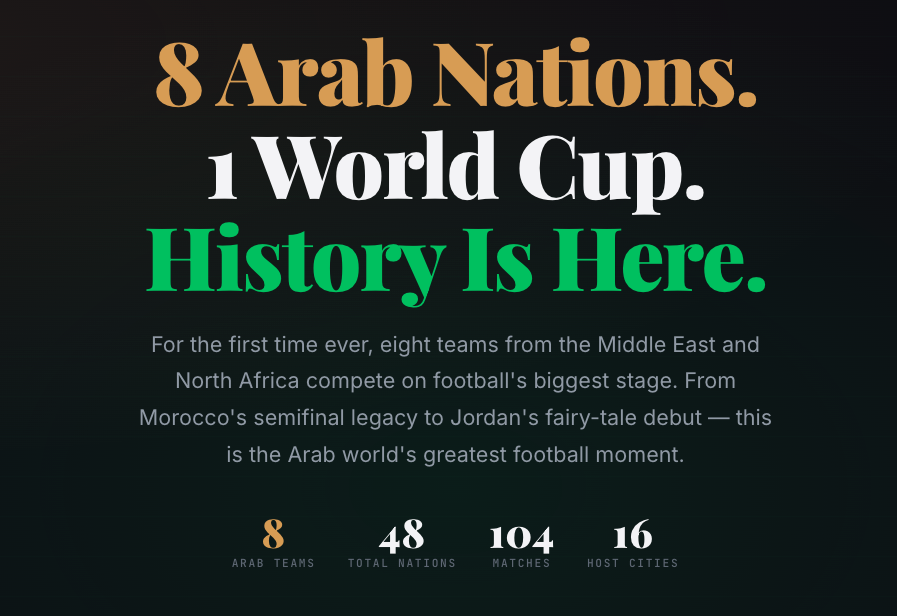
The 2026 FIFA World Cup — hosted across the United States, Canada, and Mexico from June 11 to July 19 — is the biggest edition in history. With the tournament expanded from 32 to 48 teams, the Arab world has seized its moment: a record eight nations will walk onto the pitch. In the past, just one or two Arab teams would make it. Now, one in every six squads carries the hopes of the Middle East and North Africa.

Why This World Cup Is Different
To understand just how unprecedented this is, look at the numbers. At Brazil 2014 and South Africa 2010, only one Arab nation competed. At Qatar 2022 and Russia 2018, the count rose to four — and people celebrated that as a breakthrough. Now, with Algeria, Egypt, Iraq, Jordan, Morocco, Qatar, Saudi Arabia, and Tunisia all qualifying, the region’s representation has doubled in just one cycle.
Morocco’s electrifying run to the 2022 semifinals — making them the first Arab and African team to reach that stage — shattered a psychological barrier. Suddenly, knockout-stage dreams felt realistic rather than romantic. That confidence has rippled across the region, fuelling a generation of players and fans who believe the Arab world belongs at football’s top table.
“Morocco’s 2022 run changed the way an entire region sees itself in football. These eight teams aren’t here to participate — they’re here to compete.”— The sentiment echoed across Middle East football media, June 2026
Meet the 8 Arab Nations
Key Matches Every Arab Fan Must Watch
| Date | Match | Group | City | Why It Matters |
|---|---|---|---|---|
| June 13 | 🇧🇷 Brazil vs Morocco 🇲🇦 | C | New Jersey | Biggest Arab opener — semifinalists face the giants |
| June 13 | 🇶🇦 Qatar vs Switzerland 🇨🇭 | B | Santa Clara | Gulf pride — can Qatar shine away from home? |
| June 14 | 🇹🇳 Tunisia vs Sweden 🇸🇪 | F | TBC | Critical opener for the Eagles of Carthage |
| June 15 | 🇪🇬 Egypt vs Belgium 🇧🇪 | G | Seattle | Salah vs De Bruyne — must-watch |
| June 15 | 🇸🇦 Saudi Arabia vs Uruguay 🇺🇾 | H | Miami | Giant-killer status on the line again |
| June 16 | 🇮🇶 Iraq vs Norway 🇳🇴 | I | Boston | Iraq’s return after 40 years — emotional |
| June 16 | 🇩🇿 Algeria vs Argentina 🇦🇷 | J | Kansas City | Mahrez vs Messi — blockbuster |
| June 16 | 🇯🇴 Jordan vs Austria 🇦🇹 | J | Santa Clara | Historic first-ever WC match for Jordan |
| June 20 | 🇹🇳 Tunisia vs Japan 🇯🇵 | F | TBC | The 1000th match in World Cup history |
| June 21 | 🇪🇸 Spain vs Saudi Arabia 🇸🇦 | H | Atlanta | The Green Falcons face European champions |
The Bigger Picture
This isn’t just about football. For millions across the Arab world, seeing eight flags from their region at the World Cup is a statement of belonging on the global stage. Iraq returning after four decades carries the weight of a nation that endured war and rebuilding. Jordan’s debut represents what belief and a breakthrough generation can achieve. Morocco’s continued rise proves that 2022 was no accident.
With 32 of 48 teams advancing to the knockout rounds — plus the eight best third-placed teams — the maths has never been more favourable for Arab nations to make it past the group stage. The expanded format means a solid draw and two competitive results could be enough to write history.
For fans in Bahrain, the GCC, and across the region, this World Cup will be watched in coffee shops, living rooms, and fan zones at hours that favour North American time zones. But the emotions will be entirely Middle Eastern.
Eight teams. Five weeks. One message: the Arab world doesn’t just watch the World Cup anymore — it shapes it.
What to Expect Next
Follow our coverage as the tournament unfolds. We’ll bring you match-by-match breakdowns, player spotlights, tactical analysis, and the stories behind the stories — with a lens that puts the Arab teams front and centre. The whistle blows tomorrow. History starts now.